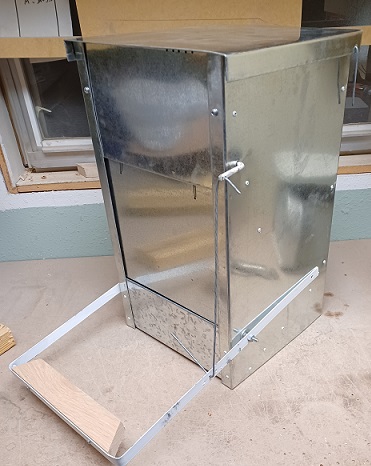
Description
F-MED $85.00 + Shipping

The Medium Feeder, F-MED, holds 33 pounds of feed, ships in a 20″ x 12″ x 12″ box with a wooden inner crate for protection, and is suitable for medium size and large size hens. The spring tension that holds the door tightly closed and prevents vermin from just pushing the door open is adjustable. A duck step can be added for ducks, turkeys, and lighter birds if you are willing to tweak the door tension to accommodate the lighter hens.
This is a handmade product and those with OCD should buy another feeder. Our focus is on durability and preventing feed theft, looks, fit, and finish are way down the list in our world. If you are not willing or capable of tweaking, repairing, and adjusting this is not the feeder for you as it requires assembly, following the instructions to the very letter, and frankly some common sense to assemble and to train a flock.
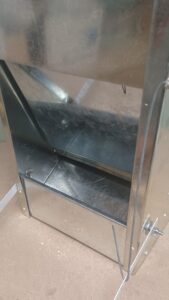
The feeder door swings in, not up, so training is much faster and easier than the Chinese made feeders like the Grandpa feeder. The feeder is also much safer as hens cannot step off the top and strangle another hen. The door tension is adjusted with two wrenches after the top front cover is removed, usually using a #1 square drive screwdriver, sometimes a #2 square drive screwdriver, or sometimes a Philipps screwdriver head.
Assembly consists of adding the two side bolts, hooking the treadle wire in place and bending over both ends, allowing the wire link to travel freely, no bending or binding to prevent premature metal fatigue in the wire link. For exterior use bend the lower front panel slightly inward so that any rain blown on the door drips down and not into the lower feed bin.
Feeders need attached to a wall or post using the included cleat that also serves to block off a small gap in the back of the feeder where the lid wire axle is located. One can stake down a good size chunk of plywood and fasten the base to the plywood or set a couple of heavy patio blocks on top the feeder to absorb vibration and to prevent tipping over when close to empty. A base made out of three patio blocks is also a good idea with plenty of room in front for a hen to easily step up onto the patio blocks before stepping on the treadle. Feeders need to be absolutely rock solid for the hens to trust the feeders.
We have a lot of customer submitted videos too that show the feeders in use, most from customers with feeders that are five, even eight years old.
There is a lot of info on these web page including videos.
This newly re designed feeder ships for about 10% less thanks to internal design changes and a reduced box size but it also holds about an extra gallon of feed. That took the feed capacity from 26 pounds up to around 33 pounds if you stuff the feeder to the gills.
The feeder also has a new adjustable door that can be shifted up and down, and even side to side should it ever be needed or if you are an OCD type person. The downside is that sometimes the door shifts during shipping and the door needs re adjusted and the screws tightened. That small adjustment also allows us to fit the doors a bit tighter than the original feeders and it eliminated the wood door block and uses a metal angle to hang the door. On the door fit, the addition of the rolled edges on the side of the feeder opening does push the door back, there is a lot of competition for space right in front of the door axle so while there is some adjustment there will likely always be a wedge shaped gap on either side but mice cannot get in, too small, too high off the ground, and too slick for them to climb up.
The front edges of the feeder sides are rolled or flanged instead of the original flat de-burred edges, making them much safer for large comb roosters.
An improved method of welding up the door axles resulted in a more precise door axle and that allowed us to pre-fit the wire links so the treadle bottoms out when the door is opened all the way if the feeder is on a level and flat surface. There will sometimes be a small amount of play but a full sized chicken ought to push the treadle bar all the way down. Feeders sometime are a bit wonky and don’t like sitting on a flat surface but once the new metal cleat attaches the feeder to the wall it is stable anyway.
The door axle has a new hard tube spacer that replaces the old split spacer which became needed once we introduced the soft close feature and the axle crank needed to stay solidly in place in a side to side manner.
It also has a new system of securing the feeder to a wall. The original wood block has been replaced by a sheet metal bracket that is fastened to the wall and the feeder dropped down over the top of the bracket so it traps the wire lid axle. This means you can remove the feeder buy just picking it up. The metal bracket also helps block off the a gap in back of the feeder that some customers worried about. Here is a video showing the features of the new hanging bracket and here is a video showing how to install the new metal bracket. If these video links do not show up hover over the words and the link will appear. Or just click on the underlined words.
And finally, the redesigned dual spring door closing system allows fine adjusting of the operating pressure needed to open the door and the spring is now out of the way up under the front cover. If you choose a soft close feeder they work even better now as there is more pressure to close the door which is needed to close the door against the back pressure of the soft close cylinder. The door can be set stiffer than before. You can go from 1.5# of pressure needed to open the door to around 5# of pressure and since the springs are now attached directly to the door there is even more pressure pre loading the door to guard against a big rat or squirrel from just pushing the door open. In the earlier models the counterweight could put back pressure on the wire link connecting the door to the treadle. With this model the wire link is always under tension, not compression. Squirrels are going to have a harder time pushing this door open.
Approximate assembled footprint size is 18” deep x 14” wide x 19” tall. The shipping box is 20″ x 12″ x 12″. The actual feeder hopper is about 11″ x 10″ x 14″ tall, partially rectangular, partially triangular shape where the door has to swing back against the feed hopper. Shipping weight is around 16 # with packaging for the medium rat proof treadle chicken feeder. When you are ready to purchase add the item to your cart and then scroll down to find the PayPal check out icon to automatically insert your shipping information. You will need to add your daytime phone number for FedEx Ground. For more information about the feeders visit our main chicken feeder web page.
If you choose the soft close option understand that soft close doesn’t mean slow close. The speed of closing depends upon the amount of door spring tension which is adjustable on the medium feeder. The soft close cylinder does moderate the shock of closing, making it easier to train hens, and if carefully tweaked by the customer a bit safer as it gives a second’s more time for a hen to pull her head out if she is eating from the sides (block the sides with milk jugs of dirt or sand), and it lessens the noise. But, you will need to set the door springs tension much lower to get a slow close action and it might not be squirrel proof after that. Feeders are set at around 4 to 5 pounds when we assemble them, giving between 1.5 and .5 pounds pressure required to push the door open which is enough for rats. That means the pressure required to pull the door crank down is around 10 pounds but the treadle has a lot of leverage so with the weight of the treadle and step that translates into 4 to 5 pounds weight needed on the treadle. If you are not able to or willing to tinker with the soft close and the spring tension then do not buy a soft close feeder.
International Orders
If you are from Hawaii or Alaska it is cheaper to use U.S. Post Office Priority mail. Their parcel post rates are not competitive with FedEx Ground here in the continental states unless the state is nearby but a feeder to Alaska or Hawaii can be shipped for around $65.00.
The easiest way is to go to the USPS.com website and generate your own shipping label, then either print and scan it, right click on the actual label when it shows up on the screen and “save as”, or just save the label as a PDF. Email the label to us, pay the cost of the product using PayPal using al@thecarentershop.net as the PayPal address and your package will go out the next business day.
International orders must be handled through a forwarding service as the paperwork is quite burdensome for even a small package. There are two ways to get this done, online package forwarding services or our new shipping partner that has an international shipping option.
Search online for package forwarding services, they will accept packages in your name, then bundle everything together and process the paperwork for exporting. Alternately, have the product shipped to a friend in the U.S. and take it back with you in your luggage when you visit. One thing to consider on international sales is that you can pack about five to nine pounds of additional product into the inside cavity of the feeder, most forwarders will consolidate packages if you ask, just make sure it will fit inside.
Using our inhouse international shipping, you have to send us your address and the products you are wanting to purchase. We can get a quote for the shipping from our shop to your house or to a terminal near your house, and an approximate cost of the tariffs and taxes and broker fees that you will need to pay.
An example, sending a medium feeder to British Columbia Canada costs around $68.52 plus another import duty/tax cost of $23.40. Once you place the order you choose the “call in a credit card” option when paying for the feeder. If it asks for an address, use 358 North Rockwell Ave, OKC, OK, 73127, use your own phone number and email address. You can put your own address in the comment section. We will take that info, get a quote on the shipping and taxes, email you, and you can call in your credit card number. We ignore any shipping costs on the order and use the quoted export shipping plus the cost of the actual shipping. Then you pay the brokerage fee, tariffs, or taxes at a local terminal when you pick up your package.
Or, we can add the brokerage costs, duties, and taxes into the shipping quote. Usually it costs us $15.00 to pay someone in your country to fill out the import paperwork in your country. That is generally cheaper than using a local import broker.
We have been told that using our in house export shipping is cheaper than using a forwarding service. And having everything pre paid speeds the import process as the customs agents know the paperwork was done by professionals and the package can be delivered to your home.
No counterweight feeder assembly instructions:
Thank you for the purchase of our feeder. There are videos of this process on our main website at ratproofchickenfeeder.net. Packed with the feeder is a plastic bag containing two short bolts, four fender washers, two ¼” nuts, and two ¼” lock nuts. A large plastic bag holds the hardware kit, an instruction sheet, a hanging cleat, and the wire link. Your feeder was assembled and tested, then disassembled and packed for shipping.
Set the feeder in the upright position and install the pivot bolts. Put one of the large fender washers on a bolt then reach inside the swinging door into the feed tray and insert the bolt through the side of the feeder, add one large fender washer and one ¼” hex nut on the outside. Do the same for the other side then tighten the nuts firmly using two wrenches. Wrench sizes are 7/16” and 10 mm.
Place the treadle over the pivot bolts protruding out from the sides of the feeder while making sure the small hole for the wire link is on the same side as the door crank and add one lock nut on each side. Tighten the lock nuts down lightly then back it off 1/8th turn so that the treadle will move freely. You will have to bend the treadle arms to line everything up and tweak it so nothing rubs.
Insert the wire link with small bent end into the hole in the end of the door axle crank rod and stick the large L bend end through the right side treadle arm, try the middle hole if there are three holes. Bend both ends of the wire link over to keep the wire link from popping off. Do not wrap the wire tight, it has to rotate freely to avoid metal fatigue. The wire link has already been installed and removed for packaging. If the swinging door doesn’t open up all the way back try using a different hole or take a pair of pliers and put a kink in the wire link if there is just one hole in the treadle. All you are doing is shortening the wire link by putting a kink in it. Watch the videos if you have any questions.
Your feeder will have two door springs already installed. To make the door easier to open for small birds just remove the top front cover and adjust the spring tension. You can even use just one spring but the stiffer the spring tension the more rat proof the feeder will be.
Installation:
Set the feeder on a couple of patio blocks or a wide platform that is raised up away from any deep litter. You want some room for the chicken to stand in front of the treadle and also in front of the treadle. There is a z shaped cleat packaged with the feeder. Hold the feeder against the wall, mark the top of the feeder using a pencil, screw the cleat to the wall about 1/8″ below the marked line. Set the feeder over the cleat, there is a sticker on the cleat with a simple link that will take you to our website video channel where you will find a video showing how to hang the cleat on the wall at the exact height. Make sure that the treadle step bottoms out on something. Adjust the wire link length if the treadle doesn’t bottom out. If the bird is trying to stand on a wobbly treadle they will not like using the feeder. Generally birds will press the treadle down with one foot and stand on the surface with the other foot which is why you want plenty of room around the treadle. It is a good idea to block the sides with gallon jugs of water or concrete blocks to force the birds to come in from the front of the feeder.
Usually the lid must be pushed to one side to get it to close completely. There will be small gaps, a triangular gap on the sides of the door and usually a narrow gap at the bottom of the door. Rats and mice will not be able to get in these narrow gaps, the gaps are too small and the metal is too slick to climb.
Email us at al@thecarpentershop.net if you have any problems, send pictures please! Don’t call, email with pictures so we can see the problem!
Training:
Thousands of these feeders are already in use. It helps if a new flock is trained correctly from day one. You’ve made a large investment in this feeder and we want to help you make it work for your flock. But do not use logic, follow the instructions to the very letter if you want fast training.
Will they be afraid of the new feeder?
Yes, chickens are prey animals; see how their eyes are on the sides of their head instead of in front like a predator? Binocular vision is for predators, side vision for prey so they have a wider field of view. Chickens are skittish by nature, it is in their genes, and they are wary of new things and things that move. Just a shadow flicking by overhead will make them run in panic even as chicks, it is genetically embedded knowledge, not experience. But if you start a flock off by showing them that the door is supposed to move when they step on the treadle and wait till they are hungry the birds will learn to use the feeder in one day.
How to train the birds
After the birds go to roost at night you make sure the feeder is installed, fastened to a wall or sturdy post, and is full of feed. Then remove ALL other feed sources except the feeder. No scraps, no treats, no free range, no old feed on the ground or in the litter, nothing but what is inside the feeder. The next morning wait till about two to three hours after sunrise and show the birds where the feed is by using your toe to trip the treadle. WHEN they are hungry enough one of them will try stepping up on the treadle. Let her eat for ten to fifteen seconds then gently push her off to see if she will try it on her own. If not, repeat the lesson. Usually one bird will try the feeder as soon as you show them where the feed is located.
IF the birds are hungry they will mob the feeder. If they are not hungry they will remain skittish of this object that they thought wasn’t supposed to move when they used it. Don’t spend a lot of time that first training session, a couple of minutes is enough if they are hungry. Go back in a couple of hours and repeat the lesson. Check on them again before they go to roost but tough love is needed to let them go to roost hungry if they aren’t using the feeder. Check again the next morning a few hours after sunrise. Remember, the treadle HAS to bottom out solidly and not wobble in the air while the bird is trying to eat. Do not mount the feeder high up on a wall, birds will fall and be trapped and killed if you do that.
Having Problems?
I can assure you that your birds are smart enough to learn but you need to go over the instructions again to make sure you have done your part. It is easy to miss something or think parts of the instructions aren’t important. Make sure the feeder has been installed according to the assembly and installation instructions, especially about securing it solidly to a wall or post so it doesn’t move around and the treadle bottom out .
Next make sure the spring is adjusted for your average bird weight, remove the top front cover and move the spring up to increase the pressure. If you have the spring set too stiff the door is noisier than it needs to be and harder to learn to use. It is not a “one size fits all” feeder, it is designed for the average bird, a Rhode Island Red. You can also remove one of the springs for a few days till they get used to the movement and noise. Follow the instructions and that loud door sounds like a dinner bell to the birds.
Follow the instructions to the letter, nothing added, nothing left out! Don’t try to set the birds on the treadle and do not block it open. If you block the feeder open you are teaching the birds that the door doesn’t have to move in order for them to eat! Just follow the instructions to the letter and the chickens will learn quickly. The reviews have several reviews were people admitted to not following the instructions and having problems that went away after they re-read and followed the training instructions.
Water resistant modifications The feeder is somewhat water resistant as the lid overhangs on all sides by a small amount but a blowing rain can hit the door and drip into the front of the feed tray. To make the feeder more water resistant set the feeder under a cover that provides at least a foot of overhang on front, down as low as possible, perhaps hinged to lift up to re fill the feeder. The cover can be made from coreplast (old political signs are great) or just about anything. Another trick if the feeder must remain outside is to carefully bend the bottom front face of the feeder in a quarter of an inch. The back, bottom, and lower front of the feeder is one long part, bend the front that is just below the door. It has a feed rake lip inside to prevent hens from raking feed, bend this in a bit to prevent water from dripping down the door into the feed.
Feed raking birds
Once or twice a year we hear from a customer that they have one or more birds raking feed out despite the inner feed rake lip that usually prevents that. In our upgrade kits and repair part section of our shopping cart we have a lip extension that is about 1.25” tall that just slips behind the front edges of the feeder and the front lip, or you can cut a section of chicken wire and lay on top of the feed inside the feeder.
User Modifications
The feeder spring system can handle an extended treadle step for smaller birds or ducks (web feet instead of a grasping claw) if needed but install the step before adjusting the springs. Thin sheet metal, 3/16” thick plywood, or any thin and lightweight material will work. We sell a Duck Step in our parts section on the shopping cart. If your birds are taking too long to acclimate you can add a wider step and whittle it down a bit each week till you are back to the original narrow treadle for maximum rat and squirrel protection. If you have long legged turkeys you can use the duck step, they will use their breast to depress the treadle.
Soft Close retrofit and installation
We have a soft close kits in the parts section of our shopping cart or you can order the soft close door in the options above.
Watch the video on installing the soft close kit. It might be an older video with a wooden bar but the process is nearly the same. Hold the metal strap level, run one of the screws through the hole in back into the side of the feeder. Hold the door tightly closed and bring the front of the mechanism down till it hits the door axle, compressing the soft close cylinder all the way, then push it back up a 1/8” inch to have clearance and insert another self taping crew in the front. Holes are Not drilled through the back layer so that the screw doesn’t strip out, use the self tapping screw to drill through that back layer and the feeder side. On the front you will find a second pre drilled hole ready for a screw. Push the soft close cylinder over so it lines up with the door axle as much as you can. If the door axle doesn’t line up with the soft close cylinder use a cresent wrench to carefully bend the axle over so it lines up. Do not go back and forth, if the axle moves side to side, you have knocked off the plastic tubing, remove the front cover and fix it.
There is a knob at the top of the soft close cylinder that decreases the closing speed. Be sure you have your springs installed before adjusting the speed. Crank the knob down till the door begins to open at the bottom and then back it off a turn. Add a foam block on the backside of the door to have an even quieter feeder. Silicone will glue styrofoam or foam rubber in place.
Email us at al@thecarpentershop.net if you have any problems, send pictures please! Don’t call, email with pictures so we can see the problem!
This feeder is radically different from the other feeders for four main reasons. First, no plastic parts that rats will eventuality chew through. Second the treadle is set way back on purpose so that if a critter or a pack of critters managed to get the treadle down when they went forward to eat they would lose the leverage and the door would close. Third, the door is spring loaded so it is nearly impossible for several rats to push it open. A dozen might do that, four or five couldn’t and usually when a feeder gets mobbed it traps a lot of rats that smother in a few hours. It also has a one piece steel treadle that won’t flex and break like the riveted aluminum or plastic treadles.
As far as competition there are three main competing products. The Grandpa feeder, the Feed o Matic from the Dutch company, and one from a company called Coops and More and a few clones of that model from other companies. All of the feeders are more expensive than our feeder
The Grandpa feeder is a pretty feeder but three times the cost or our feeder. It is also what is called a guillotine feeder that goes up and down instead of swinging back. That makes it hard to train the birds. To train a flock using the Grandpa feeder you HAVE to block the feeder open for a week or more. There are dozens of negative reviews on the product. The Grandpa feeder is also made in China, not New Zealand as they claim in their marketing.
The Feed o Matic is the green plastic top and plastic feed tray feeder once sold on Amazon and still sold on several other websites by re-sellers. The 26 pound model sells for $95.99, more than our standard feeder, but they do offer free shipping. Now the average feeder shipping is around $22.00. The feeders are made in Holland by a company called Olba and after lackluster sales in the EU due to design flaws they started dumping them on the U.S. to get rid of them. You can buy pallets of them and there are many re sellers of the product. One reseller, Hog Slat, posts a warning in bright red text stating that rats can push the door open and that rats can chew through the plastic feed tray and lid. The treadle is way too large, rodents or pigeons can swarm the feeder and hold the door open. It is made for smaller birds, too small for Rhode Island Reds, lots of complaints on the Amazon shopping cart page, around 30% of the reviews are critical of the product for a wide variety of reasons. Not only that, but the initial reviews all have a disclaimer that said they received the product for free in return for their review! Amazon recently made that illegal and grounds for banning the company from Amazon. The treadle on this feeder can also be jammed if the litter builds up or if the birds track a lot of chicken poop on the treadle. And the door isn’t spring loaded so rats and even small mice can easily enter the door just by pushing on it. They advocate blocking the feeder open while training and customer reviews say it can take several weeks sometimes to train their birds. That is because blocking a feeder open is the worst thing to do during training because it teaches the birds that the treadle and door are not supposed to move. The Feed o Matic jams a lot according to the reviews, especially when the treadle is blocked open. One review said the feeder leaked and their feed was molding. Other reviews say the birds don’t like sticking their heads so deep into the machine. With a critical review rate of 30% this product won’t last long on Amazon before Amazon pulls it from the market. (update August of 2021: Amazon did pull the product from their platform due to excessive returns.)
The Chicken Condo feeder has several clones out there, all with the same fatal flaws. The door isn’t spring loaded or counter weighted so a mouse or rat can just push its way into the feeder. They have a complicated treadle step frame made of many sections of aluminum angle and metal fatigue and cracking ensue rapidly till the door no longer operates. Rats and pigeons can also swarm the treadle due to its large size treadle. The birds can’t see the feed until they stick their head way up under the feeder. The door swings up, not back, so the potential for trapping a bird’s head is high. The doors are complicated, many parts, and prone to wear and jamming in a dirty chicken coop. The marketing videos on these types of feeders advocate leaving the feeder blocked open for several weeks during training, not a good thing to do if you are buying a feeder because of vermin stealing the feed because it also teaches the vermin where the feed is and how to push the door open. Our feeder tried out the multi component treadle bar, the complicated arrangement for linkages fastened to the door to operate, and we quickly learned to eliminate both the complicated door and the multi part treadle due to the treadles failing rapidly. Instead we invested in the equipment to weld a solid steel axle, only one moving part, and nearly bullet proof. This also allows the spring loaded adjustable door that eliminates the possibility of several rats or a squirrel from pushing the feeder door open. These Chicken Condo type clones were so bad for business that one company named Coops N More pulled their feeder from the market and it was an almost exact clone of the Chicken Condo feeder.
Buyers should be wary. Read the reviews and if there are many critical reviews that is the best indication of a poorly designed feeder. The Amazon feeder has a 30% negative review rate but when you look at the company’s profile they claim a 100% positive rate so they do have control over the ratings and reviews on Amazon.

Reviews
There are no reviews yet.